
Falling Pickaxe by Pixmove: the rules of a single reel
Falling Pickaxe is a Pixmove slot with a single reel, five spin outcomes, pickaxes with HP from 100 to 400, blocks with HP from 1 to 30, and a Max Win of 160× the bet.
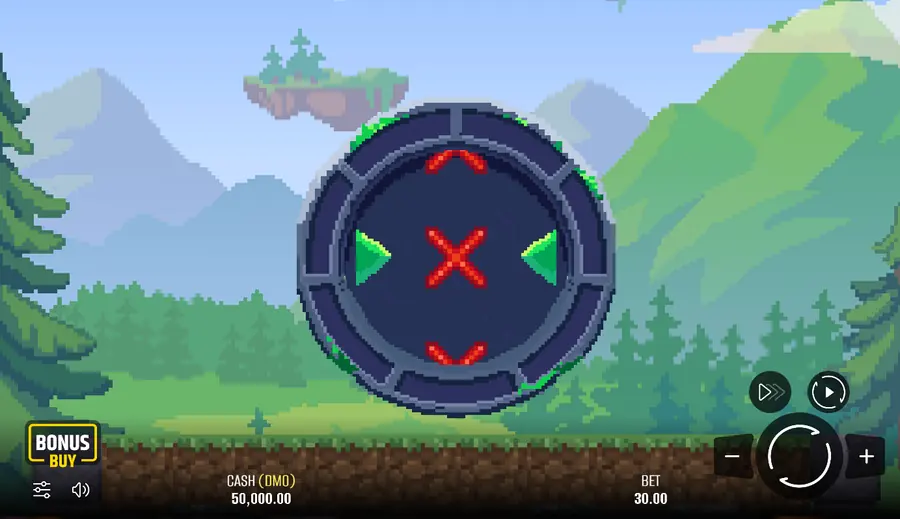
Falling Pickaxe is a slot from provider Pixmove with a single reel that shows a cross or one of four pickaxes on every spin: wooden, stone, iron or diamond. When a pickaxe lands, it falls through the mine and destroys blocks until its own HP runs out; after that, the game adds up the payouts for the destroyed prize blocks and credits the total. The game runs on an RTP of 95%, has low volatility and a maximum win of 160× the bet, and all of this is broken down step by step below.
📑 Table of contents
- What is Falling Pickaxe
- How a game round plays out
- Blocks and the paytable
- Four pickaxes and their HP reserves
- Special objects on the playing field
- Buy Bonus: choosing a guaranteed pickaxe
- RTP, volatility and maximum win
- Bet and game controls
- Responsible play and the technical condition
- Pros & Cons
- FAQ
1 What is Falling Pickaxe

Falling Pickaxe is a slot machine with an unusual structure: instead of the usual symbol reels, there is one reel here, and the result of its spin determines whether a pickaxe falls and which one. The slot is made by provider Pixmove, and its main feature, the falling pickaxe, is reflected in the very name Falling Pickaxe.
The playing field looks like a vertical shaft made of pixel blocks of different types. The reel sits at the top and shows one of five outcomes on each spin: a cross (Cross) or one of the pickaxes, wooden, stone, iron or diamond. If a pickaxe lands, it starts moving down through the layers of blocks and strikes them; if a cross lands, the round ends without a fall, and no new payouts are added.
The basic cycle of one round: spin → reel result → if a pickaxe lands, its fall with block destruction → accumulation of payouts for destroyed prize blocks → end of the round when the pickaxe's HP reaches zero → summing and paying out the total. Before playing for real money, it helps to study Falling Pickaxe in demo mode and get used to the interface without financial risk.
2 How a game round plays out
Every round starts the same way: the player presses Spin, and the single reel at the top of the screen runs a short animation. Once it stops, one of five possible outcomes is visible, a cross or a pickaxe of one of four types. This is the moment that determines whether the pickaxe will move in the current round, or whether the spin turns out to be "empty".
If a cross lands, the round closes instantly: no pickaxe appears, no blocks are destroyed, and no new payouts are added. If a pickaxe lands, it appears at the top edge of the shaft and starts falling down, hitting the blocks beneath it one after another. With each strike it destroys the section of block caught in its contact zone and keeps moving until its own HP reaches zero.
The round ends in one case only: when the pickaxe's HP has hit zero and it has stopped moving. At that moment the game shows the final sum, made up of the payouts for all prize blocks destroyed during that round, and moves on to the next spin. So in Falling Pickaxe there are no familiar "lines" or "combinations": the win is built along the path of a single pickaxe through the shaft.
Reel results and the rule of seven crosses
The reel of Falling Pickaxe has exactly five possible outcomes, and the rules list them without any additional options: Cross, Wooden Pickaxe, Stone Pickaxe, Iron Pickaxe and Diamond Pickaxe. There are no multiplier symbols, jokers or scatters here; everything that can land fits into this short list.
The rule of seven crosses works like this: if seven spins in a row end with a cross, the eighth spin is guaranteed to show one of the four pickaxes on the reel. This cuts off long streaks of empty spins, but it is worth understanding the exact boundaries of the guarantee. First, what is guaranteed is the fact that a pickaxe lands, not a specific type: it can be wooden, stone, iron or diamond, and the game does not promise any one of them individually. Second, a guaranteed pickaxe is not a guaranteed cash win: the pickaxe can still fall onto blocks with no prize payouts and finish the round with zero.
The rules also do not directly disclose the probabilities of each pickaxe landing, so you cannot compare the odds between Wooden, Stone, Iron and Diamond by the numbers; the player has no basis for considering one type more likely than another.
Strikes and the durability of pickaxes and blocks
Simple arithmetic sits at the core of a round: every strike reduces the pickaxe's HP and the block's HP by exactly one point at the same time. No damage modifiers, bonus attacks or special conditions exist; one contact equals minus one point of durability on both sides. This makes the mechanic transparent: looking at the pickaxe's HP and the block's HP is enough to work out how many strikes will be needed.
When a block's HP reaches zero, it disappears from the shaft, leaving empty space in its place. If it is a prize block, its multiplier is added to the round's accumulated win; if it is dirt or stone, the payout is zero and the block simply vanishes without a reward. The pickaxe keeps falling as long as there are new blocks ahead of it.
When the pickaxe's HP reaches zero, the fall stops and the round closes regardless of whether any blocks remain in the shaft. This is the key limitation: even if emeralds lie ahead, a pickaxe with zero HP cannot break them. The pickaxe's durability reserve is, in essence, the round's "fuel", and it directly determines how many blocks, and of what type, the player manages to break through.
When the final win is credited
In Falling Pickaxe there are no step-by-step payouts after each destroyed block: the game does not show an increase at the moment copper or redstone disappears. Instead, every destroyed prize block increases an internal accumulator, and the actual amount only appears on screen once the round ends.
The end of the round is the moment when the pickaxe's HP reaches zero and it stops moving. At that point the game adds up all the payouts accumulated during the round and shows the final total. If no prize block was destroyed during the pickaxe's fall (for example, the pickaxe only hit dirt and stone), the total is zero no matter how many strikes were made.
This scheme matters for understanding strategy: even a long round with dozens of strikes pays nothing if the pickaxe only hit blocks with a zero payout. Conversely, a short round with two or three strikes on redstone, gold or emerald can produce a noticeable total. That is why in Falling Pickaxe the number of strikes in itself does not matter; what matters is which blocks they landed on.
3 Blocks and the paytable
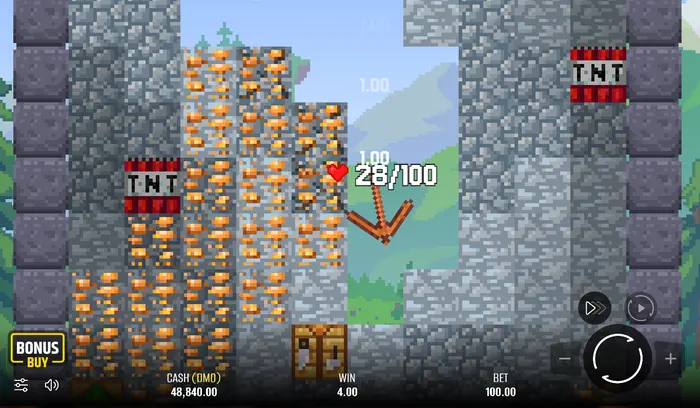
Seven main types of blocks appear in the shaft of Falling Pickaxe, and the rules describe each of them with two numbers: an HP reserve (durability) and a payout from the bet for its destruction. These numbers are not linked: a block with high HP does not necessarily pay more, and a block with a big payout is not necessarily the most durable. Below is the full table as given in the rules.
| Block | HP (durability) | Payout from bet |
|---|---|---|
| Dirt | 1 | 0× |
| Stone | 1 | 0× |
| Copper | 5 | 0,01× |
| Redstone | 10 | 0,05× |
| Gold | 15 | 0,2× |
| Diamond | 20 | 1× |
| Emerald | 30 | 5× |
This table is easy to misread, so it is worth separating two concepts. HP is the number of strikes needed for a block to disappear: an emerald, for example, requires 30 strikes, while one strike is enough for dirt. The payout is the bet multiplier added to the round's total when the block is destroyed: the same emerald gives 5× the bet, while dirt and stone give nothing. These two characteristics are independent, and comparing them head-on ("the emerald has 30 HP, so it is 30 times more valuable than stone") is a mistake.
One more important distinction: the 5× for an emerald is the payout for a single destroyed block, not the slot's maximum win. The Max Win in Falling Pickaxe is 160× the bet according to the characteristics card, and that is a completely different ceiling: getting close to it requires collecting payouts along a chain of rare blocks in one round, and a single emerald does not come anywhere near that limit.
4 Four pickaxes and their HP reserves
The game has four pickaxes, and each differs only in its HP reserve; the rules describe no bonus payout multipliers or special effects on the pickaxes themselves. This matters so that you do not attribute properties to the wooden or diamond pickaxe that the rules do not contain: pickaxes here are not "better" or "worse" in terms of payouts, they differ only in how deep they can go in one round.
| Pickaxe | HP |
|---|---|
| Wooden Pickaxe | 100 |
| Stone Pickaxe | 150 |
| Iron Pickaxe | 200 |
| Diamond Pickaxe | 400 |
The Wooden Pickaxe with 100 HP has the shortest reach: it is enough to get through a shaft of not-too-durable blocks, but on a long row of redstone or gold it runs out quickly. The Stone Pickaxe gets 150 HP, the Iron Pickaxe 200, and the Diamond Pickaxe 400, exactly four times more than the wooden one.
It seems logical to assume that Diamond is always better, but the rules make an important caveat: a larger HP reserve only means the possibility of more strikes, not a guarantee of a bigger win. A diamond pickaxe with 400 HP can dig down through solid dirt and stone and end with zero, while a wooden one with 100 HP can, in one short round, randomly hit an emerald and bring 5× the bet. So choosing a pickaxe is not "buy the biggest one and take the bank"; it is more a decision about how long a round the player is willing to pay for.
5 Special objects on the playing field
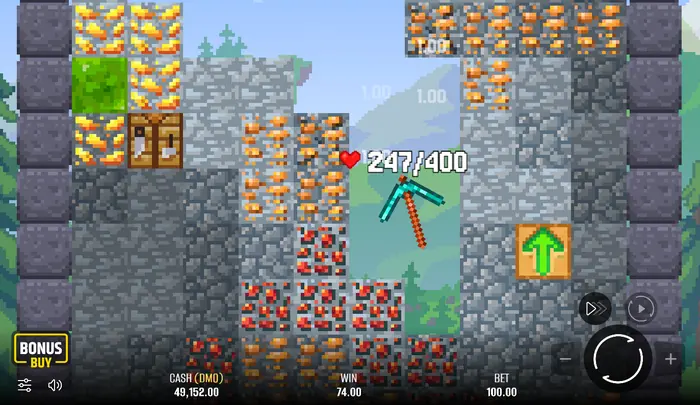
Besides ordinary blocks, three special objects appear in the shaft of Falling Pickaxe, described in the rules: TNT, Upgrade Arrow and Workbench. Their effects are known only in general terms; the exact radii, durations and reward formulas are not disclosed in the rules, and they cannot be invented. Below we look at how these objects work during a round.
- TNT is an explosive that, when its block is destroyed, detonates and destroys neighbouring blocks within a certain radius. The exact size of the radius and the order of crediting rewards for the explosion are not specified in the rules.
- Upgrade Arrow is an upgrade arrow that temporarily increases the physical size of the pickaxe and widens its area of impact. It is a size multiplier, not a win multiplier.
- Workbench is a workbench that fully restores the current pickaxe's HP and raises its level along the chain Wooden → Stone → Iron → Diamond.
These three objects do not appear at every step; they show up in the shaft among the ordinary blocks, so they cannot be treated as a constant mechanic. They are more like random events capable of sharply changing the course of one particular round. Each one's detailed behaviour is covered in the following sections.
TNT: exploding blocks
TNT in Falling Pickaxe works as a point charge: when the pickaxe destroys a block with TNT, an explosion occurs instead of the usual single destruction, and neighbouring blocks within a certain radius disappear along with it. It is the only object in the game that destroys more than one block in a single event.
However, the rules leave several important details unspecified. The exact blast radius is not given; the rules say only "within a certain radius", with no numbers or diagram. It is also not described how the explosion counts toward the win: whether payouts for blocks destroyed by the blast use the same multipliers as ordinary pickaxe strikes, or whether different rules apply. Nor is it disclosed how the explosion affects the pickaxe's own HP consumption: whether the strike is deducted as one contact or as several.
The player should treat it as a "bonus event" whose outcome cannot be calculated in advance, and not attribute to it any payouts not stated in the rules.
Upgrade Arrow: temporary pickaxe enlargement
The Upgrade Arrow is an arrow that, when destroyed, temporarily increases the physical size of the pickaxe. This means the pickaxe on screen becomes larger and covers a bigger area of blocks with each strike, destroying them faster. In itself this does not change the payout multipliers or grant bonus rewards; it is purely a visual and mechanical effect on the area of impact.
The upgrade steps are described in the rules as follows: the first collected arrow increases the pickaxe's size to 1,5× of the original and lasts 3 seconds. If during that time the pickaxe destroys another Upgrade Arrow, the size grows to 2×, and a third arrow brings it to 2,5×.
For the first step, the effect lasts 3 seconds. How long exactly the second (2×) and third (2,5×) levels last is not stated in the rules, so there is no basis for treating them as "permanent" or, conversely, as "the same 3 seconds". It is also important not to confuse this mechanic with a win multiplier: even a 2,5× pickaxe pays for blocks exactly what the paytable states, and adds nothing on top.
Workbench: restoration and upgrade
The Workbench is, in essence, a workbench that performs two functions at once when destroyed: it fully restores the current pickaxe's HP and raises its level. These two effects work together, so hitting a Workbench can extend the round and make the pickaxe more powerful at the same time.
The upgrade chain is strictly fixed: Wooden → Stone → Iron → Diamond. This means a wooden pickaxe becomes a stone one with 150 HP after a Workbench, a stone one becomes iron with 200 HP, and an iron one becomes diamond with 400 HP. For a diamond pickaxe, the Workbench can no longer raise the level any higher, so it only fully restores its durability to the same 400 HP.
The rules do not describe the Workbench as a source of cash payouts or a series of free spins. This means that encountering it in the shaft is a valuable event for the round's duration, but not a reason to expect a separate reward beyond what the pickaxe collects along the way. If a diamond pickaxe still runs into dirt and stone after a Workbench, the round's total will remain zero; an HP reserve does not substitute for a payout.
6 Buy Bonus: choosing a guaranteed pickaxe
Buy Bonus in Falling Pickaxe is a purchase function available through a separate menu. It lets the player choose the pickaxe type in advance and pay for it, after which the next reel spin is guaranteed to produce exactly that pickaxe, not a cross and not a random type. It is a convenient way to start a round right away with the HP reserve you want, skipping the waiting period of the "rule of seven crosses" or the random distribution.
At the same time, it is important to understand what is guaranteed and what is not. The purchase guarantees that the chosen pickaxe will land on the next spin. The purchase does not guarantee a cash win: even a diamond pickaxe with 400 HP can pass through empty blocks with no prize payouts and finish the round with zero. The purchase also does not provide a series of free spins: it is one spin, not a free spins package, even though the Buy FreeSpin field in the game's technical card has the value Yes; in the context of Falling Pickaxe it describes precisely the purchase of a pickaxe bonus, not classic free spins.
For those planning to play for real money, it helps to learn about playing for real money and the related financial conditions in advance: buying the bonus spends funds from the main balance and requires deliberate bet management.
Purchase options and cost multipliers
Buy Bonus in Falling Pickaxe offers four purchase options, one for each pickaxe type. The cost of each option is expressed as a multiplier of the base bet: the more powerful the pickaxe, the higher the coefficient. Below is the table of values as given in the rules.
| Purchase | Guaranteed pickaxe | Pickaxe HP | Cost multiplier |
|---|---|---|---|
| Wooden Pickaxe | Wooden | 100 | 2,99× |
| Stone Pickaxe | Stone | 150 | 5,65× |
| Iron Pickaxe | Iron | 200 | 8,44× |
| Diamond Pickaxe | Diamond | 400 | 10,5× |
These multipliers are purchase cost coefficients, not win multipliers. They cannot be read as "the diamond pickaxe multiplies the win by 10,5×" or "the wooden one increases the prize 2,99 times". This is the price the player pays on top of the usual bet to get the corresponding pickaxe on the next spin.
The cheapest purchase is Wooden at 2,99× the bet, the most expensive is Diamond at 10,5× the bet. Between them sit Stone (5,65×) and Iron (8,44×). Choosing an option is essentially a decision about the ratio of "purchase price to pickaxe HP reserve", and the rules give no basis for considering any of the four options objectively better than the others: the probabilities of prize blocks and special objects appearing in the shaft are not disclosed.
Purchase formula and limitations
The cost of buying the bonus in Falling Pickaxe is calculated simply: the bet amount at purchase equals the base bet multiplied by the corresponding multiplier. With a base bet of 100, buying Wooden costs 299, Stone 565, Iron 844, and Diamond 1050. With a base bet of 1000, the same coefficients give 2990, 5650, 8440 and 10500 respectively. This arithmetic follows directly from the multiplier table and contains no hidden surcharges.
The purchase has several important limitations that players often overlook. First, the purchase guarantees only the pickaxe type, not a cash win: even a Diamond Pickaxe bought for 10,5× the bet can pass through the shaft without a single prize block and end at zero. Second, the purchase does not provide free spins; it is one paid spin, not a series. Third, a separate RTP for Buy Bonus is not stated in the rules, so the long-term return of purchased bonuses cannot be compared with ordinary spins by the numbers.
It is also important not to confuse the Buy FreeSpin = Yes field in the technical card with buying free spins. In the context of Falling Pickaxe it reflects the existence of a bonus purchase function in principle, but the actual mechanic is Buy Bonus with a guaranteed pickaxe, not a classic free spins package. Any wording like "buy free spins" does not apply to this game.
7 RTP, volatility and maximum win
The characteristics card of Falling Pickaxe lists three key figures: RTP 95%, volatility Low and Max Win 160× the bet. These values are often taken as a single "game profile", but in fact they describe completely different things and do not add up into one indicator. It helps to keep them in mind separately.
RTP 95% is the theoretical long-term return to player, calculated across the entire set of spins. Volatility Low is a qualitative characteristic of the win distribution: it says how wins are spread around the average, but does not set an exact frequency or size. Max Win 160× is the declared upper limit of a win in one round, a ceiling above which the game does not pay. Each of these values is covered in detail in the following subsections.
What RTP 95% means
RTP 95% in Falling Pickaxe means that theoretically, over a very long distance of millions of spins, the game returns 95% of the total amount wagered as payouts. It is a mathematical expectation averaged over the whole playing session, not a promise of a specific return on a specific evening.
Over a short session, RTP hardly works as a forecast at all. You can make ten spins in a row and not even reach half of what you staked, or you can collect several emeralds in one round with a diamond pickaxe and end up in profit. Neither scenario contradicts RTP 95%, because that figure describes the game's behaviour over a huge sample of spins, not one session and not one bet. So RTP cannot be used as an argument that "the next spin is obliged to return part of the losses"; the game carries no such obligation.
The currency of the base bet is not stated in the rules, so there is no basis for naming specific cash amounts or comparing RTP with an actual return in a particular currency. Specific monetary conditions, including currency, limits and settlement procedures, should be checked with the chosen platform.
How to read Low and Max Win 160×
The Low label next to the volatility parameter in Falling Pickaxe is a qualitative, not a numerical, characteristic. It indicates a relatively even distribution of wins compared with high-volatility slots, but it sets neither a specific win frequency, nor their average size, nor the depth of possible losing streaks. No numerical volatility value is given in the rules.
Max Win 160× is a different story entirely: it is the declared maximum the game can pay out in one round. Here it is important not to confuse it with the three other numbers found in the rules. 5× is the multiplier for destroying a single emerald block. 10,5× is the cost multiplier for buying the diamond pickaxe in Buy Bonus, not a win multiplier. 160× is the game's overall ceiling. These figures are about different things, and comparing them with each other ("the emerald gives 5× and the maximum is 160×, so you need 32 emeralds") is a typical mistake, because Max Win is made up of payouts for different block types in one round, not from single multiplications.
8 Bet and game controls
The base bet range in Falling Pickaxe is set in the bet selection interface: the minimum value is 10, the maximum is 20 000. The bet currency is not stated in the rules, so there is no basis for calling these numbers "dollars", "rubles" or any specific currency; they are parameters of the game interface, which in real conditions are displayed in the currency of the chosen operator.
The controls are concentrated at the bottom and on the right side of the screen. Spin starts the reel spinning and begins the round. Buy Bonus opens the purchase menu for one of the four pickaxes with the cost multipliers already described. The + and − buttons change the base bet step by step, and in some interface versions a slider is also available for quick adjustment. Turbo switches the accelerated animation mode on and off. Auto opens the automatic spins menu. Sound controls the audio, and Menu opens a side panel with the rules, paytable and settings. For those playing from a phone, it is convenient to check access to the game on mobile in advance and make sure the interface displays correctly on a mobile device.
Automatic spins and Turbo
The Auto mode in Falling Pickaxe launches a series of automatic spins: the player chooses the number of spins through the Auto menu, after which they run in a row at the same base bet. This is convenient when you want to watch a long series without pressing Spin manually each time, but remember that the bet is fixed at the moment Auto is started and does not change from spin to spin.
You can stop the series of automatic spins by pressing the Auto button again; this interrupts the chain and returns the game to manual mode. Pressing Spin while Auto is active does not stop the series, it only speeds up the reel animation for the current spin, which is handy if you want to get through the series faster and reach the round you are interested in.
Turbo is a separate mode that works independently of Auto. It speeds up the spin and pickaxe fall animations without changing either the bet or the spin result. Turbo can be switched on and off at any time, including during an active Auto series, and it applies to all subsequent spins until the next switch.
9 Responsible play and the technical condition
As in any slot, the outcome of each spin in Falling Pickaxe is determined by the game itself and cannot be predicted in advance: no previous spin sets the result of the next one. This means that attempts to "chase a win" by increasing the bet after a losing streak have no basis in the rules: every spin follows its own reel and shaft logic. So the practice of controlling time and budget, a pre-set session limit and the readiness to stop once it is reached, remains the only working strategy.
The game rules state the technical condition directly: "Malfunction voids all pays and plays", that is, in the event of a technical malfunction, all payouts and game results are declared void. This is a standard industry clause and it needs to be taken into account: in the event of a connection failure, an interface error or another technical incident, the round's result may be annulled. If you play for real money, it is important to choose a licensed operator with transparent rules and support that records such cases.
Pros & Cons
Pros
- One reel with five clear outcomes, and it takes minimal time to get into the game
- A clear paytable for seven block types with specific multipliers from 0,01× to 5×
- Buy Bonus with four cost options lets you start a round right away with the pickaxe you need
- The rule of seven crosses cuts off long streaks of empty spins and gives a guaranteed pickaxe on the eighth spin
- The pickaxe upgrade chain through the Workbench adds depth within a single round
Cons
- Max Win of 160× is rather modest by the standards of slots with aggressive mechanics, and the rules do not disclose exactly how it is reached
- Dirt and stone with HP 1 and a payout of 0× take up pickaxe strikes with no return, slowing the path to prize blocks
- The probabilities of specific pickaxes and special objects landing are not disclosed in the rules, so the real frequency of costly events cannot be estimated
- Buy Bonus spends funds from the balance with no guarantee of payback and no separate purchase RTP
- The Buy FreeSpin = Yes field in the technical card is easy to misread as buying free spins, although in fact it is buying a pickaxe
The key decision factors for Falling Pickaxe are RTP 95%, low volatility and a Max Win of 160× the bet. These are confirmed values from the characteristics card, and comparing them directly with other slots by these figures is not advisable: the rules set no numerical volatility and do not describe how the 160× ceiling is actually built up from block payouts. Combined with the focus on short rounds and Buy Bonus, the game is positioned as a casual slot for short sessions.
FAQ
How do you play Falling Pickaxe and what should you do in each round?
The player presses Spin, and the reel shows one of five outcomes. With a cross, the round closes without a fall; with any pickaxe, it falls through the shaft and destroys blocks until its HP runs out; the game adds up the payouts for the destroyed prize blocks and shows the total.
What is guaranteed after seven crosses in a row, and what is not?
Only the fact that one of the four pickaxes lands on the eighth spin is guaranteed. Neither the specific pickaxe type nor a cash win is guaranteed: the pickaxe can pass through blocks with no payouts, and the round's total will remain zero.
How do the four pickaxes differ, and does the pickaxe type affect the win?
The pickaxes differ only in their HP reserve: Wooden 100, Stone 150, Iron 200, Diamond 400. A higher HP allows more strikes but does not increase the payout for blocks; the total depends on which blocks the pickaxe actually destroyed.
What is Buy Bonus, and does it buy free spins?
Buy Bonus is the purchase of one of the four pickaxes for the next spin at multipliers of 2,99×, 5,65×, 8,44× and 10,5× of the base bet. The purchase guarantees the pickaxe type, but neither a cash win nor a series of free spins.