
Falling Pickaxe demo: learning the mechanics without risk
The demo button launches Falling Pickaxe on a virtual balance: you can test spins, bets, pickaxe and block HP, payouts and Buy Bonus for free.
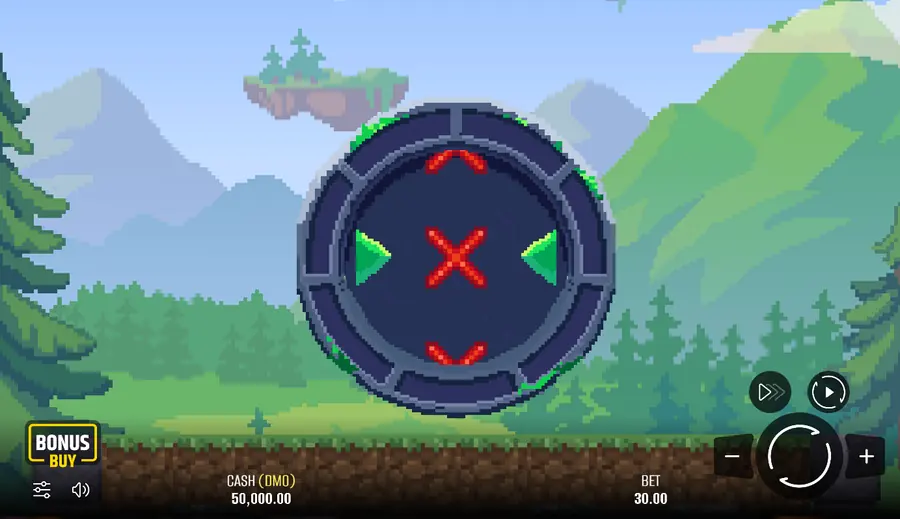
Falling Pickaxe is a single-reel slot from provider Pixmove in which a pickaxe falls through layers of blocks and accumulates payouts until its HP runs out. Demo mode offers the same mechanics in virtual interface units, with no real money deducted and no way to withdraw the round's result. Below we explain what to watch for during trial spins: from the control buttons and the BET panel to how HP changes, how to read the paytable and how the Buy Bonus menu works.
📑 Table of contents
1 What demo mode in Falling Pickaxe gives you
Demo play in Falling Pickaxe exists for one purpose: to let you play with virtual units before real money is at stake. The mechanics here are unusual: there are no familiar paylines, the reel is a single one, and the pickaxe falls vertically through blocks while spending its own HP supply. Working out this logic on the fly is hard without trial spins: it is unclear when a round will end, which blocks pay out and which only slow the pickaxe down.
What to pay attention to in a trial game:
- The location and purpose of the Spin, +, −, Auto and Turbo buttons.
- Reel behavior: five possible outcomes and the order in which they land.
- How the pickaxe's and a block's HP decrease from hit to hit.
- How payouts for prize blocks accumulate and how the total is recorded in the WIN field.
- How the Buy Bonus menu opens and what it actually provides.
The full table of mechanics and rules is collected on the main pageFalling Pickaxe .
2 Virtual balance and the limits of trial play
The virtual balance in the demo consists of internal interface units, not real money. They exist so you can spin the reel, change the bet with the + and − buttons and watch the credits the way they would look in money mode.
A few limits worth understanding:
- Any amounts in the CASH and WIN windows relate to the virtual balance and cannot be withdrawn.
- Balance resets and the availability of virtual funds are set by the platform, not by the game itself.
- The interface does not specify a bet currency, so converting the numbers into rubles, dollars or any other real currency is meaningless.
A detailed comparison of the virtual balance and a real bet is collected in the article on how the trial mode differs from playing for money.
3 How to study the interface and start a round
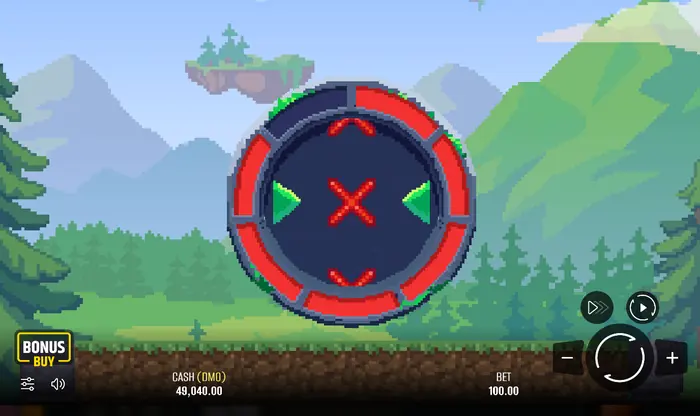
The screenshot shows the main screen with a pixel background, a large round reel in the center and a control panel at the bottom. In the lower left corner there is a yellow Buy Bonus button and a sound icon; in the center, the CASH indicator with the balance; on the right, the BET field with the bet, bet adjustment buttons and a round Spin button with two arrows. Above Spin are the Auto and Turbo icons.
The sequence for starting a round looks like this:
- Check the BET field, which shows the current bet. If needed, change it with the + and − buttons.
- Press Spin, and the reel will start spinning.
- Watch the result of the spin: either a cross lands (the round is not active) or one of the four pickaxes.
- If a pickaxe lands, it begins falling through the blocks, reducing their HP and its own HP with each hit.
- Wait for the round to end, when the pickaxe's HP reaches zero, and check the final amount in the WIN field.
The layout of elements may differ between versions of the game on different platforms, so orient yourself by what the buttons do rather than by their exact position on the screen.
Setting the bet and the control buttons
The functions of the buttons in the demo are defined by the game rules, while their placement and availability depend on the platform version.
- Spin starts the reel spinning and the round itself, if a pickaxe lands.
- + and − increase or decrease the base bet within a range from 10 to 20 000.
- Auto opens the automatic spins menu; the selected number of spins runs at the same bet, and pressing Auto again stops the mode.
- Turbo enables accelerated animation; pressing Spin during autoplay speeds up the spinning further.
- Buy Bonus opens the menu for buying a chosen pickaxe (more details in a separate section).
The game rules state that the currency of the base bet is not designated in the interface, so the values 10 and 20 000 should be read as game units with no tie to any specific currency.
How to read HP and the round result
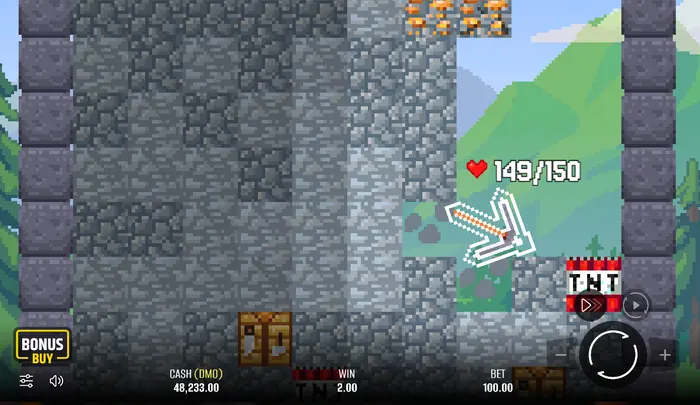
The second screenshot shows an active round: on the left, a wall of gray stone blocks; on the right, a flying pickaxe with a 149/150 indicator, and below it, a TNT block. CASH, WIN and BET are displayed at the bottom, and the spin control buttons are in the lower right corner.
What this screen shows:
- The pickaxe HP indicator (149/150) means that after one hit the stone pickaxe has lost 1 HP out of 150.
- Each hit on a block reduces the HP of both the pickaxe and the block by 1.
- When a block's HP reaches zero, the block is destroyed; prize blocks add a payout to the accumulated total.
- When the pickaxe's HP reaches zero, the round ends and the WIN field shows the total win from all destroyed prize blocks.
Dirt and stone pay 0× the bet, so destroying them does not increase the win. This is an important point: a long strip of dirt and stone can end the round with almost no payout.
4 Pickaxes, blocks and special effects in the demo
In Falling Pickaxe there are four types of pickaxes, differing in their HP supply. The more HP a pickaxe has, the more hits it delivers before the round ends.
- Wooden Pickaxe, 100 HP.
- Stone Pickaxe, 150 HP.
- Iron Pickaxe, 200 HP.
- Diamond Pickaxe, 400 HP.
A larger HP supply does not automatically mean a larger win: the result depends on which blocks end up in the pickaxe's path. The wooden pickaxe can bring a large sum if it immediately hits emeralds, while the diamond one can finish on a strip of dirt and stone.
In the demo, three special objects deserve attention. They appear at random and are not guaranteed in every round:
- TNT explodes when destroyed and wipes out neighboring blocks within a certain radius. The exact size of the radius is not specified in the rules.
- Upgrade Arrow temporarily increases the physical size of the pickaxe, expanding its destruction zone. This is not a win multiplier but a change to the geometry of the hit.
- Workbench restores the pickaxe's HP and raises its level: wooden → stone → iron → diamond. At the diamond stage, the Workbench only restores durability.
These objects make rounds more varied, but treat them as game mechanics rather than as promised bonuses of every trial session.
Studying payouts and block durability
The game has seven main block types. They differ in durability (HP) and in the payout from the bet for destroying them. These are two separate characteristics: HP shows how many hits are needed to destroy a block, while the payout shows how much is added to the round total.
| Block | HP | Payout from bet |
|---|---|---|
| Dirt | 1 | 0× |
| Stone | 1 | 0× |
| Copper | 5 | 0,01× |
| Redstone | 10 | 0,05× |
| Gold | 15 | 0,2× |
| Diamond | 20 | 1× |
| Emerald | 30 | 5× |
Dirt and stone are destroyed with a single hit but pay nothing. Emerald requires 30 hits, yet brings 5× the bet for each destroyed block. That is the largest single multiplier in the paytable, but it should not be confused with the slot's maximum win: the Max Win in Falling Pickaxe is 160× the bet and applies to the whole round, not to a single block.
Buying the bonus: not buying free spins
The Buy Bonus button opens a menu with four purchase options. Each option guarantees that the chosen pickaxe will land on the next spin, but it provides neither a cash win nor a series of free spins.
- Wooden Pickaxe, 100 HP, purchase multiplier 2,99×.
- Stone Pickaxe, 150 HP, purchase multiplier 5,65×.
- Iron Pickaxe, 200 HP, purchase multiplier 8,44×.
- Diamond Pickaxe, 400 HP, purchase multiplier 10,5×.
These multipliers determine the bet amount when buying the bonus, not the size of a future win. For example, with a base bet of 100, buying the diamond pickaxe costs 1 050 game units. The multiplier of 10,5× is the purchase price, not a promise of receiving 10,5× the bet on top.
In the characteristics card, the Buy FreeSpin field is set to Yes, but in practice the game offers exactly Buy Bonus with a guaranteed pickaxe. Therefore, phrases like "buy free spins" or "buy a series of free spins" do not apply to Falling Pickaxe.
5 How the demo differs from playing for money
The difference between the modes lies not in the mechanics but in what is at stake. In the demo, the interface's virtual balance is used, and every bet and every win exists only inside the game window. In money mode, the bet is deducted from a real account, and the round result forms a payout that can be withdrawn.
What stays the same:
- Reel behavior and the set of five possible outcomes.
- The table of block HP and payouts.
- The operation of Buy Bonus with the same four pickaxe options.
- Long-term parameters: RTP of 95%, low volatility, maximum win of 160× the bet.
What differs:
- The source of funds for the bet: virtual balance versus a real account.
- The presence or absence of registration, verification and responsible gambling rules, which is the platform's area of responsibility.
- The availability of the mode on a specific site or in an app.
A full comparison is collected in the article on how the trial mode differs from playing for money.
6 What the demo cannot predict
Trial play honestly shows the mechanics, but it does not predict the results of real sessions. This is a fundamental limitation, and it is worth understanding before moving to money mode.
An RTP of 95% means that over the long run the game returns 95% of bets to players. It is a mathematical characteristic calculated over millions of spins. A single session of a hundred spins can end either in profit or at a loss; RTP does not describe the outcome of any particular evening.
Low volatility is a qualitative characteristic of the win distribution. It does not set the exact hit frequency, the average win size or the magnitude of a possible drawdown, so relying on it as a forecast for a specific session is not valid.
The demo also gives no answer to the question of what the next round will be. Reel behavior is determined by a random number generator; you can study the rules, but not the patterns of outcomes.
7 Safe boundaries for trial play
Demo mode removes the financial risk but does not cancel the basic rules of responsible gambling. The game is intended only for adult users; if the demo opens inside a casino app or on an operator's site, those requirements are set by the platform.
Before moving from a virtual balance to a real account, it helps to define two boundaries in advance:
- A session budget: the amount a player is willing to spend without harming everyday expenses.
- A time limit: a set amount of time for play, after which the session ends regardless of its result.
The same boundaries apply to trial play: even a virtual balance should not turn into an endless session. Questions of mobile access to the game are covered separately in the article on how to open the game on a mobile device.
FAQ
Can you play Falling Pickaxe for free without casino registration?
The platform sets the conditions for launching the demo: whether a trial mode exists and whether registration is required are determined by the site or app, not by the game itself. Before launching, check whether the chosen platform offers a Free Demo without logging into an account.
How does the virtual balance in the demo differ from a real account?
The virtual balance consists of internal interface units; the round result in the demo is not a cash payout. In money mode, bets are deducted from a real account and wins form a payout. The mechanics, paytable and Buy Bonus work identically in both modes; details are in the section "Virtual balance and the limits of trial play".
What exactly does buying the bonus in Falling Pickaxe guarantee?
Buy Bonus guarantees only that the chosen pickaxe will land on the next spin. The purchase does not guarantee a cash win and does not start a series of free spins; details and the multiplier table are in the section "Buying the bonus".
Does the demo predict real game results, and what does an RTP of 95% mean?
The demo shows the mechanics but does not predict random results. An RTP of 95% is a long-term theoretical indicator calculated over millions of spins and does not describe the outcome of a single session; details are collected in the section "What the demo cannot predict".