
Falling Pickaxe for real money: rules and limits
In real-money mode, Falling Pickaxe uses your actual account balance rather than a virtual one, so before your first deposit it's worth checking the specific site's terms and your own limits.
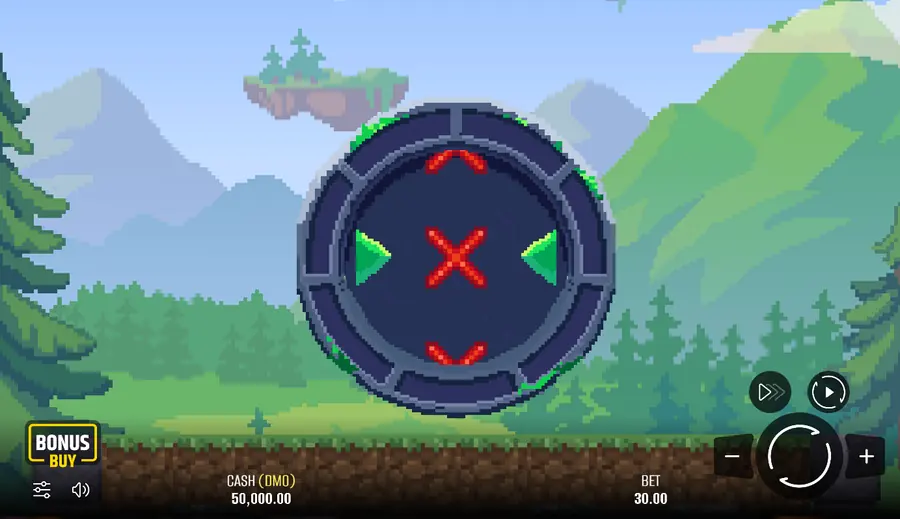
In real-money mode, every spin deducts the stake from your casino account, and any win is credited back to that same account. The provider Pixmove keeps the same parameters as in demo mode: RTP of 95%, low volatility, and a maximum win of 160× the stake. The only thing that changes is what you're risking: a loss reduces real funds, not virtual units. Below we'll go over what exactly to check on the site before depositing, how the pickaxe purchase price is calculated, and why no slot characteristic promises income in any single session.
📑 Table of contents
1 What playing for real money means
In real-money mode, Falling Pickaxe differs from the demo in exactly one way: instead of a virtual balance, the interface uses an account funded with the site's real currency. Every spin deducts the base stake from it, and winnings are returned the same way. The slot itself doesn't change: one reel, a falling pickaxe, block destruction, and rewards accumulating until the end of the round.
Two practical consequences follow from this. Lost funds can no longer be 'reloaded' the way a demo's virtual balance can. And the site adds its own layer of rules that don't exist in the slot itself: the settlement currency, deposit and withdrawal limits, account verification, and regional restrictions. Whether real-money mode is available is decided not by the provider Pixmove but by the platform you choose, so you need to check the actual terms exactly where you plan to play.
2 What to check on the site before playing
Before depositing funds, run through a short checklist. It requires no special knowledge, but it reduces the risk of unpleasant surprises after your first deposit.
- Actual mode. Make sure the site offers exactly the slot you were looking for, and that it runs in real-money mode rather than demo.
- Current rules. The list of payment methods, restrictions, and bonus terms can change, so check the current version on the website.
- Region and age. Access to gambling is regulated by local law; check whether play is permitted in your jurisdiction and from what age.
- Account and verification. Find out in advance which documents may be requested when withdrawing funds and how long they take to review.
- Currency and displayed stake. The interface should show the same currency you're depositing with; otherwise the final deducted amount will depend on the platform's internal exchange rate.
This checklist is equally useful whether you're still choosing a site or you've already registered and want to move from demo to a real account.
Region, age, and account rules
Regional and age restrictions apply to the site, not to the slot itself. In some countries online gambling is allowed from age 18, in others from 21, and in a number of jurisdictions access to such games is closed entirely. The provider Pixmove doesn't set these limits; it only supplies the game.
Account rules typically describe what's needed to register, which documents will be requested during verification, whether one person may hold multiple accounts, and what happens in case of suspicious activity. These terms affect whether you can withdraw your winnings, so it's worth reading them before depositing, not after requesting a payout.
Payments, limits, and currency
The slot isn't tied to any specific currency or payment system, but the site only works with the ones it supports. Before depositing, check three things: which currency your account uses, which deposit and withdrawal methods are available in your region, and whether there are fees or limits on individual transactions. Limits can differ by an order of magnitude between platforms, so there are no universal figures here.
The stake display rule deserves separate attention. If the slot interface shows values in one currency while your account is opened in another, the final deducted amount will depend on the platform's internal exchange rate. That's a feature of the specific site, and you can check it in the help section or account rules.
3 Stakes and session budget
Before playing, set a session budget and choose a base stake that lets you stick to that limit. The slot interface shows a minimum bet of 10 and a maximum bet of 20 000; the actual monetary amount is displayed in the casino account's currency and depends on the site. The bet range is set by the platform, not by the provider Pixmove.
Also check the Buy Bonus price before confirming a purchase: it's calculated as the base stake multiplied by the coefficient of the chosen pickaxe, and it can be noticeably higher than the price of a regular spin. Factor the full deducted amount into your session budget in advance.
4 Buy Bonus and its cost
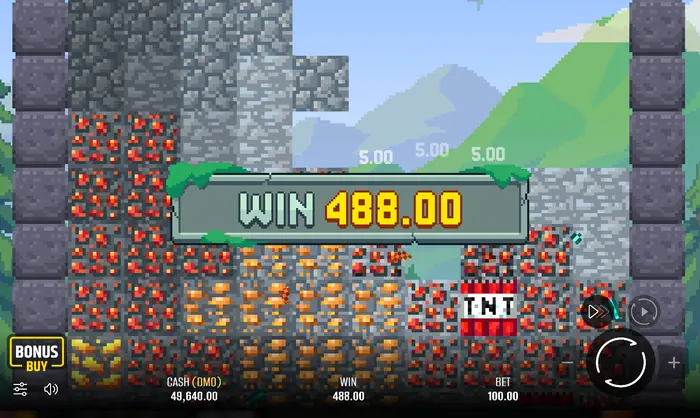
Buy Bonus in Falling Pickaxe is a way to get the pickaxe type you want right away: instead of waiting for it to land on the reel, the player chooses the Wooden, Stone, Iron, or Diamond Pickaxe and pays for the purchase. The cost follows a simple formula: the base stake multiplied by the chosen pickaxe's coefficient.
This is a crucial point that's easy to mix up. The 10,5× multiplier on the Diamond Pickaxe applies to the amount deducted, not to the size of your future win. The Diamond Pickaxe costs 10,5 times more than a regular spin, but it doesn't promise a payout 10,5 times bigger. That's why a bonus purchase counts as an elevated-size stake, not a guaranteed way to make money.
The gameplay screenshot illustrates the slot's interface and the placement of the Buy Bonus button, but it doesn't confirm any monetary result: the numbers shown on screen belong to the demo balance, not a real account.
Pickaxe purchase coefficients
The Buy Bonus cost differs for each pickaxe type. The four values from the rules are listed in the table below.
| Purchase | Guaranteed pickaxe | Base stake multiplier |
|---|---|---|
| Wooden Pickaxe | Wooden | 2,99× |
| Stone Pickaxe | Stone | 5,65× |
| Iron Pickaxe | Iron | 8,44× |
| Diamond Pickaxe | Diamond | 10,5× |
These coefficients only determine the purchase price. They don't describe the size of a future win, how often blocks land, or the odds of breaking even. A full breakdown of how three similar numbers (5× for an emerald block, 10,5× for buying the Diamond Pickaxe, and 160× Max Win) relate to different quantities can be found in the review of the slot's mechanics and characteristics.
What the purchase actually guarantees
Buy Bonus guarantees exactly one thing: the next spin will land the chosen pickaxe type rather than a cross. That's all. The guarantee doesn't imply any specific monetary win, any recovery of the deducted amount, or any series of free spins. The slot's rules don't disclose a separate RTP for the Buy Bonus options, so you can't apply the overall figure of 95% to the purchase or treat it as the expected value of buying.
In short, the purchase only removes the wait for a cross on one spin and immediately gives you a pickaxe with the corresponding HP reserve. After that, everything follows the normal mechanics: the pickaxe destroys blocks, spends durability, and the win accumulates until the HP runs out. Whether the stated maximum of 160× the stake applies to a purchased bonus is also not clarified in the rules.
5 RTP, volatility, and win cap
The slot card lists three key characteristics: RTP of 95%, low volatility (Low), and a maximum win of 160× the stake. All three numbers describe the game as a whole, not an individual session or a specific spin. They're different quantities that can't be added together or compared directly.
The Low label is a qualitative volatility rating. It doesn't set an exact hit frequency, an average win size, or the magnitude of possible drawdowns, so it shouldn't be read as a promise of 'frequent' or 'modest' payouts. The Max Win of 160× is a ceiling the slot won't pay above no matter how many blocks you destroyed. None of these numbers promises profit on any given evening.
How to read an RTP of 95%
RTP stands for Return to Player. A value of 95% means that over millions of spins, the slot returns roughly 95% of the total amount wagered as winnings. The remaining 5% is the site's mathematical advantage.
This figure only works as an average over a huge sample. In a single session of ten or a hundred spins, the result can be anything: up or down, and deviations from the average over short runs can be very large indeed. 95% is not a promise to return 95 of every unit wagered, and it's not a guarantee that a winning streak will necessarily begin after a losing one. Random outcomes stay random at any stake and with any strategy.
No separate RTP for the Buy Bonus options is given in the rules, so the overall figure of 95% can't be applied to the purchase directly. The same limitation covers how the stated maximum of 160× the stake applies to a purchased bonus: the rules don't clarify that either.
Stakes and a responsible decision
The slot's rules don't disclose the probabilities of individual pickaxes and special objects landing, nor do they set separate probabilities for the Buy Bonus mode. That means neither raising your stake nor buying the Diamond Pickaxe is described in the rules as a way to increase the chance of a large payout, and the RTP of 95% can't be extended to the purchase.
The practical takeaway is simple: it's better to set your budget and playing time before you start, rather than adjusting them to the current result. Don't play with borrowed money, don't try to 'win back' losses after a bad run, and don't extend a session just because 'this next spin will surely be lucky'. If your set limit is exhausted, stopping is the wiser move than changing your stake in the hope of bending a random outcome.
6 Switching between demo and real-money mode
Before risking real funds, it makes sense to first get to know the game in demo mode, if the site offers one. The demo uses a virtual balance, so you can calmly watch how the pickaxe falls, how HP is spent, which blocks pay out, and what buying each pickaxe type looks like. That's especially useful because Falling Pickaxe has no familiar paylines or symbols, and understanding the mechanics only comes after a few rounds.
The demo is useful for learning the rules, not for predicting wins: results are generated randomly and don't depend on which mode you launch the game in. The financial and platform conditions of real-money mode remain a separate topic, covered in the sections above.
7 Responsible play
Falling Pickaxe, like any other slot, remains a game of chance with the risk of losing money. Only adult users are allowed to play it, and only in regions where such entertainment is permitted by law. The slot is not a source of income and cannot be treated as a way to earn money, whatever characteristics its card may list.
The practical side of responsible play is simple: set a budget and time limit before the session starts, don't exceed it during a winning streak or a losing one, and treat a bonus purchase as an elevated-size stake, not an investment. If your control over the game weakens, it's better to take a pause and, if needed, reach out to specialized support services, links to which are usually published on the responsible gaming page of the site you've chosen.
FAQ
Can you play Falling Pickaxe for real money?
The slot itself allows it: the stake, Buy Bonus, and payouts work the same in any mode. Whether real-money mode is available is decided by the chosen site and region, so check the actual terms on its website.
How much does a bonus purchase cost in Falling Pickaxe?
The cost equals the base stake multiplied by the chosen pickaxe's coefficient: Wooden 2,99×, Stone 5,65×, Iron 8,44×, Diamond 10,5×. That's the purchase price, not a multiplier of your future win. No separate RTP for the Buy Bonus options is given in the rules.
What exactly does Buy Bonus guarantee?
Only that the chosen pickaxe will land on the next spin. The purchase doesn't guarantee a monetary win, recovery of the deducted amount, or a series of free spins; the rules also don't clarify how the maximum of 160× the stake applies to a purchased bonus.
Does an RTP of 95% mean I'll get my money back?
No. 95% is an averaged return over an enormous distance, not a forecast for a specific session. Over short runs, the result can differ noticeably from that value in either direction. On top of that, the RTP of 95% describes the game as a whole and doesn't extend directly to a bonus purchase, for which no separate RTP is disclosed.